


Two studies evaluated ENHERTU vs other
HER2-positive mBC treatments
In adults with HER2-positive metastatic breast cancer who had not yet received their first treatment for metastatic disease
ENHERTU in combination with pertuzumab is the biggest breakthrough for people starting HER2-positive metastatic breast cancer treatment in over a decade.* This gives people a chance to live longer without their cancer advancing.
*Compared to a taxane-based chemotherapy, Herceptin® (trastuzumab), and pertuzumab combination. Scroll down to learn more.
ENHERTU with pertuzumab was compared to THP in a clinical study of adults with different ages† and hormone receptor statuses.
Of the adults in the 2 groups studied:
ENHERTU + pertuzumab
THP
Based on the results of this study, ENHERTU in combination with pertuzumab is FDA approved for adults with HER2-positive mBC who have not received prior therapy for their metastatic breast cancer.
†Patients studied were 20 to 88 years of age.
THP, taxane-based chemotherapy, Herceptin® (trastuzumab), and pertuzumab.

In adults with HER2-positive mBC who had received prior treatment for metastatic disease
ENHERTU was compared to ado-trastuzumab emtansine in a clinical study of 524 adults with different ages* and previous treatments who:
- Had positive levels of HER2 proteins
- Had breast cancer that was unresectable (cannot be removed with surgery) or metastatic†‡§
- Had already received a prior treatment for HER2-positive mBC or had cancer come back during or within 6 months of treatment after surgery
Of the 524 adults studied:
ENHERTU
ado-trastuzumab emtansine
*Patients studied were 20 to 83 years of age.
†Patients had various hormone receptor statuses.
‡Tumors that had spread (metastasized) to other parts of the body, including the liver, lungs, and bones.
§Including patients with tumors that had spread to the brain and were stable.




In adults with HER2-positive metastatic breast cancer who had not yet received their first treatment for metastatic disease
ENHERTU in combination with pertuzumab is the first treatment combination to help people live longer without their cancer growing and spreading compared with THP.
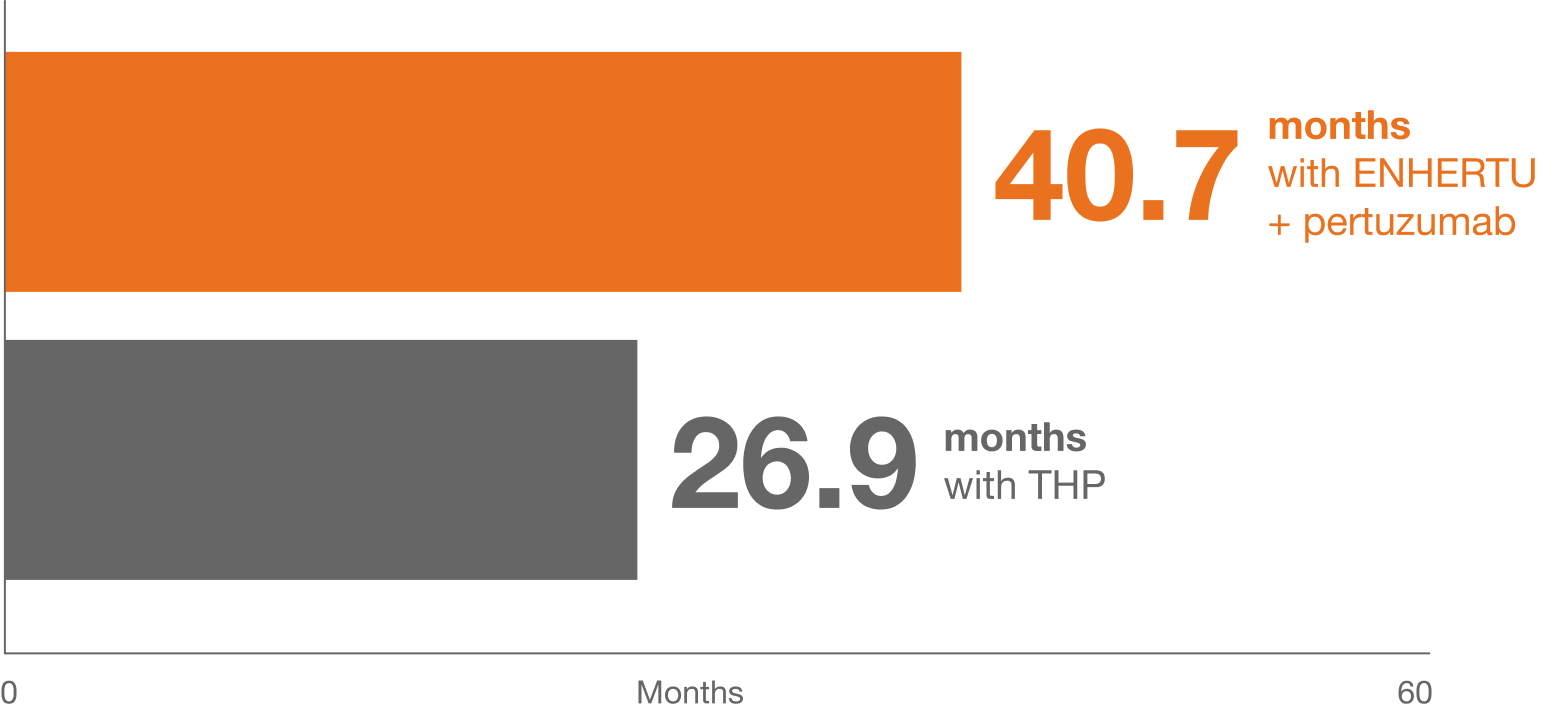

Median progression-free survival is the amount of time from the start of treatment
that half of the patients are alive without their cancer growing or spreading.
Majority of tumors shrink or disappear from scans

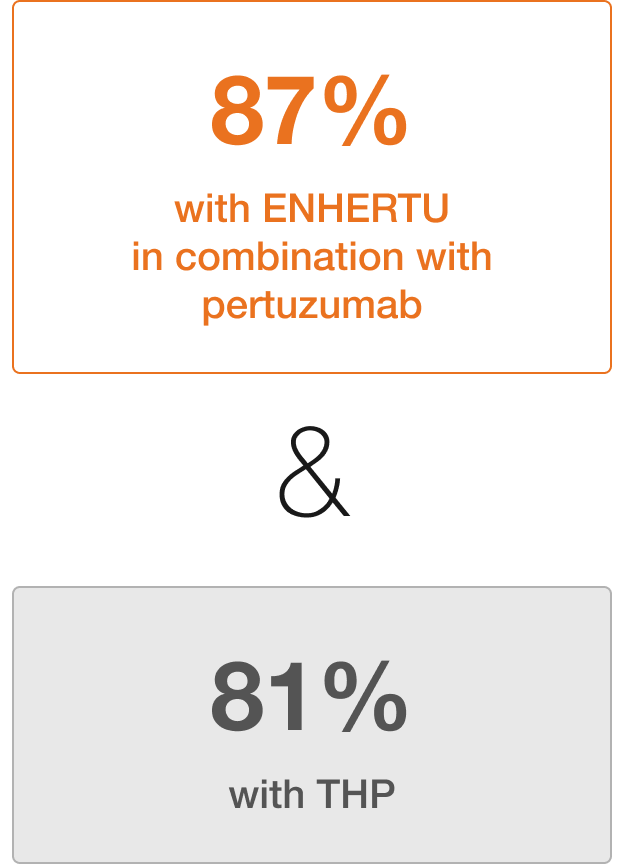
Overall response rate is the proportion of patients who have a partial or complete response to therapy.*
- 15% (56 of 374) of people achieved a complete response who received ENHERTU in combination with pertuzumab and 8% (30 of 371) of people who received THP. A complete response means the tumor could not be seen on imaging tests
- 72% (268 of 374) of people achieved a partial response who received ENHERTU in combination with pertuzumab and 73% (271 of 371) of people who received THP. A partial response means the tumor shrank by at least 30%
*Not tested for statistical significance and not designed to show differences between treatments. Statistical significance describes a mathematical measure of difference between groups. The difference is statistically significant if it is greater than what might be expected to happen by chance alone.
Disease control rate
With ENHERTU in combination with
pertuzumab, 95% (356 of 374) of
people had their tumors:


Disease control rate is the percentage of people who have achieved complete response, partial response, or stable disease. Stable disease means tumors did not increase in size 20% or more or decrease in size 30% or more.*
*Not tested for statistical significance and not designed to show differences between treatments. Statistical significance describes a mathematical measure of difference between groups. The difference is statistically significant if it is greater than what might be expected to happen by chance alone.

In adults with HER2-positive mBC who had received prior treatment for metastatic disease

ENHERTU helped people live longer without their cancer growing or spreading compared with ado-trastuzumab emtansine
were more likely to be alive without their cancer progressing compared with ado-trastuzumab emtansine
Progression-free survival is the amount of time from the start of treatment that a person is alive without their cancer growing or spreading.
At the time of data analysis (May 2021), median progression-free survival was not yet reached for people receiving ENHERTU. This means that more than half of people who started treatment with ENHERTU were alive without their cancer growing or spreading. This compares to half of the people who started treatment with ado-trastuzumab emtansine who reached median progression-free survival at about 7 months before their cancer began to grow or spread.
- 67% (174 of 261) of people treated with ENHERTU were alive at the time of data analysis without their cancer progressing, compared with 40% (105 of 263) of people treated with ado-trastuzumab emtansine
People receiving ENHERTU lived longer compared with people receiving ado-trastuzumab emtansine
Overall survival data was not available in the initial assessment in May 2021, but positive data emerged in July 2022

At the time of updated data analysis, more than 50% of people receiving ENHERTU or ado-trastuzumab emtansine were still alive (July 2022)*
- ENHERTU reduced the risk of death in patients by 36% vs ado-trastuzumab emtansine
- 65% (170 of 261) of people treated with ENHERTU were alive at the time of this data analysis (median follow-up was 28.4 months), and 52% (138 of 263) of people treated with ado-trastuzumab emtansine were alive at the time of data analysis (median follow-up was 26.5 months)
Median overall survival with ENHERTU and ado-trastuzumab emtansine (November 2023)†
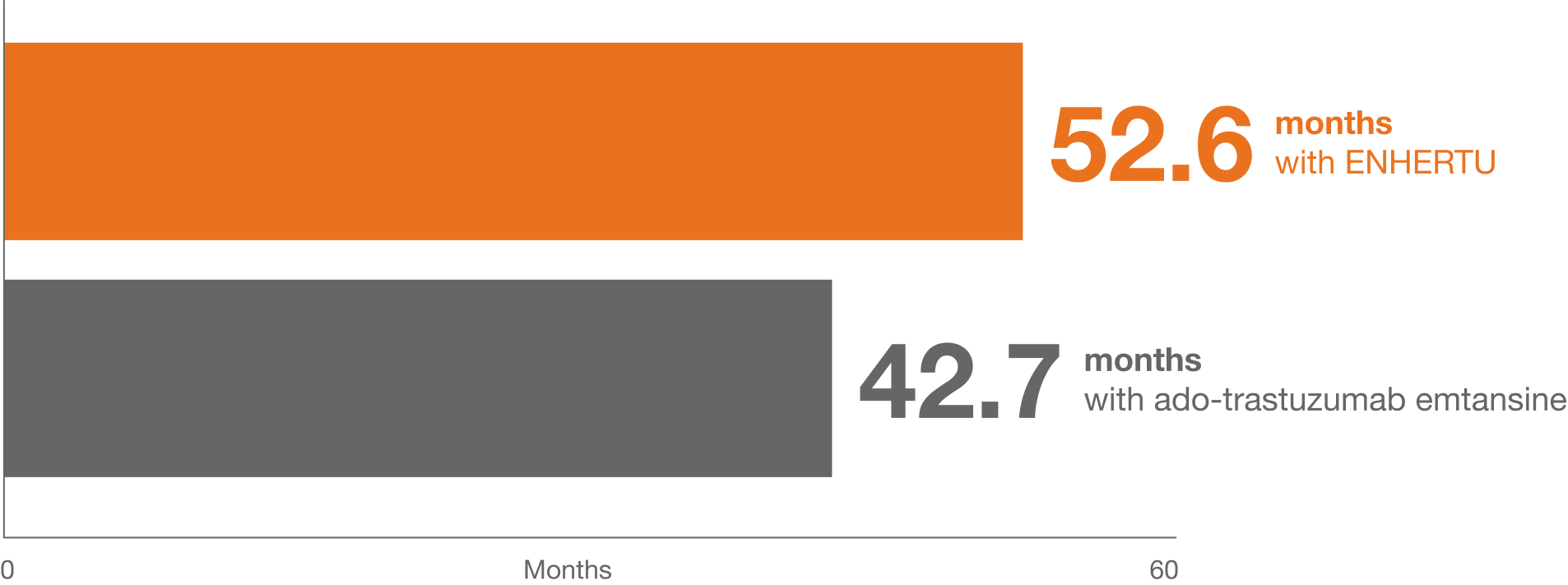
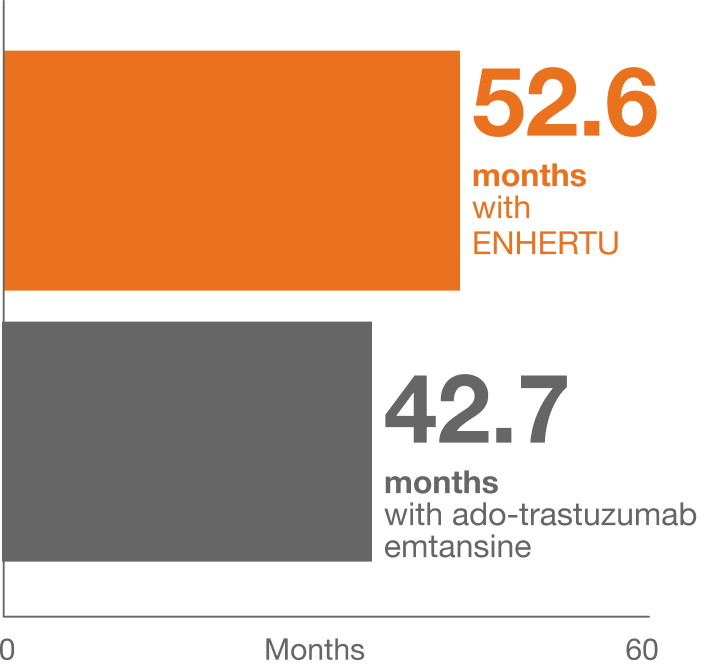
Median overall survival is the length of time, from either the day of diagnosis or the start of treatment, that half the patients in a group are still alive. A median is the middle number in a set of numbers.
*At the time of data analysis, since more than 50% of people receiving ENHERTU or ado-trastuzumab emtansine were still alive, the results could not be reported in months.
†These study results were based on an exploratory analysis, which was not intended to compare the two treatments. The study was also open-label, meaning that both the patients and trial investigators knew which treatment patients received. Therefore, the results could have been influenced by people switching to another treatment, leaving the study, or other factors. This means the results of the exploratory analysis cannot be fully explained and may not be the effect of the treatment. Each person's experience may differ. Speak with your doctor about what you may expect.
In the first assessment, more people had their tumors shrink with
ENHERTU than with ado-trastuzumab emtansine (May 2021)*

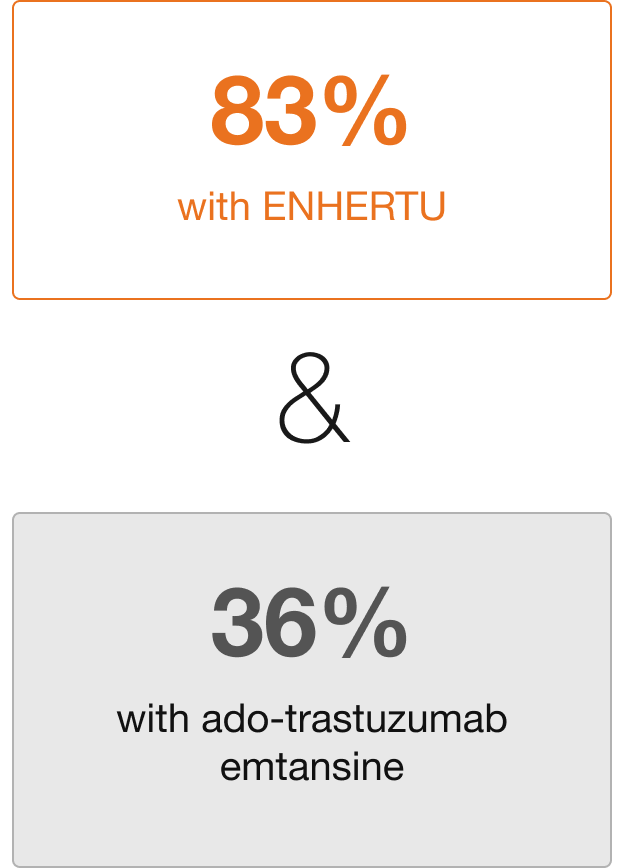
Overall response rate is the proportion of patients who have a partial or complete response to therapy.
Of the people who responded to treatment†:
- 16% (39 of 248) of people achieved a complete response with ENHERTU and 8% (20 of 241) of people treated with ado-trastuzumab emtansine. A complete response means the tumor could not be seen on imaging tests
- 67% (166 of 248) of people achieved a partial response with ENHERTU and 28% (67 of 241) of people treated with ado-trastuzumab emtansine. A partial response means the tumor shrank by at least 30%
In an updated assessment (July 2022)‡:
- 82% of people had their tumors shrink with ENHERTU
- 37% of people had their tumors shrink with ado-trastuzumab emtansine
Of the people who responded to ENHERTU in the updated assessment:
- 21% (52 of 246) of people achieved a complete response with ENHERTU and 9% (21 of 240) of people treated with ado-trastuzumab emtansine
- 61% (150 of 246) of people achieved a partial response with ENHERTU and 28% (67 of 240) of people treated with ado-trastuzumab emtansine
*These study results were based on an exploratory analysis, which was not intended to compare the two treatments. The study was also open-label, meaning that both the patients and trial investigators knew which treatment patients received. Therefore, the results could have been influenced by people switching to another treatment, leaving the study, or other factors. This means the results of the exploratory analysis cannot be fully explained and may not be the effect of the treatment. Each person's experience may differ. Speak with your doctor about what you may expect.
†Based on the people in the first assessment with measurable disease (248 people who received ENHERTU and 241 people who received ado-trastuzumab emtansine). In the first assessment, 83% (205 of 248) of people had their tumors shrink with ENHERTU and 36% (87 of 241) of people with ado-trastuzumab emtansine.‡Based on the people in the updated assessment with measurable disease (246 people who received ENHERTU and 240 people who received ado-trastuzumab emtansine). In the updated assessment, 82% (202 of 246) of people had their tumors shrink with ENHERTU and 37% (88 of 240) of people with ado-trastuzumab emtansine.
Disease control rate
In the first assessment (May 2021), 98% (242 of 248) of
people treated with ENHERTU had their tumors respond to
treatment in at least one of the following ways:
The disease control rate is the percentage of patients who have achieved complete response, partial response, or stable disease.*
*Not tested for statistical significance and not designed to show differences between treatments. Statistical significance describes a mathematical measure of difference between groups. The difference is statistically significant if it is greater than what might be expected to happen by chance alone.

Understand possible side effects

Learn more about ENHERTU
HER2, human epidermal growth factor receptor 2; mBC, metastatic breast cancer; THP, taxane-based chemotherapy, Herceptin® (trastuzumab), and pertuzumab.